Tiffany Packaging: Why the Blue Box Became Iconic
Tiffany packaging decoded—history, Pantone 1837, real vs fake, unboxing psychology & a guide to crafting Tiffany-like rigid box solutions.

Table of content
Few brand elements in retail have the instant recognition and emotional pull of the Tiffany box. The Tiffany packaging — robin’s-egg “Tiffany Blue” box, crisp white satin ribbon, velvet or suede pouch, and a perfectly finished rigid box — transforms a product into a memory. For luxury and premium brands across the U.S., Europe, and Australia, the Tiffany box is more than a container: it’s a status symbol, marketing tool, and free ambassador every time someone shares an unboxing photo.
This article is an in-depth guide to Tiffany’s packaging: its history, the design and manufacturing features that make it iconic, how to spot authentic vs fake Tiffany packaging, and a practical, manufacturer-level playbook you can use to create Tiffany-like rigid boxes and premium unboxing experiences — with hands-on recommendations tailored to brands who order from packaging partners like GUKA Packaging.
A short history: how the Tiffany box became a cultural icon
- Origins: Tiffany & Co., founded in 1837, introduced its Blue Book and an associated blue shade in the 19th century; that color later evolved into the trademarked Tiffany Blue (Pantone 1837).
- From utility to symbol: What began as protective wrapping became a deliberately designed touchpoint — the box itself was never sold separately, reinforcing exclusivity.
- Cultural momentum: Appearances in film, celebrity gifting, and art collaborations (limited-edition reinterpretations) cemented the box as an object of desire.
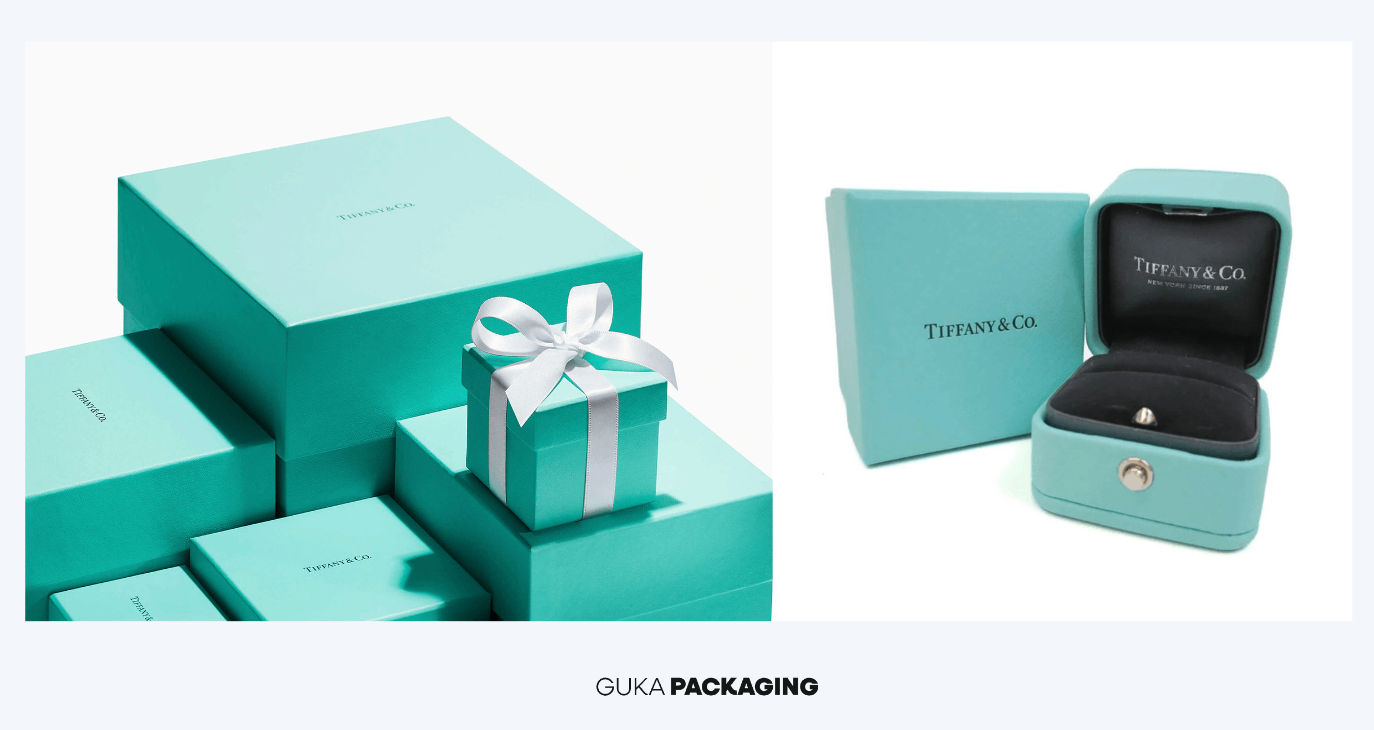
The anatomy of Tiffany packaging: design, materials, and finish
Here’s why Tiffany’s package works at a technical and emotional level.
1. Color fidelity: Pantone 1837
- Tiffany Blue is a brand signature — a non-verbal identifier that triggers recognition even without a logo.
- To reproduce color reliably you must: use Pantone matching, request printed swatches, and perform press/color proofs; consistency across batches and substrates is crucial.
2. Box structure: rigid board engineering
- Typical luxury rigid boxes use high-GSM, multi-ply rigid paperboard for weight, sharp corners, and durability (factory specs often reference boards in the higher GSM range for premium feel).
- Common structures: two-piece rigid box (separate lid & base), magnetic closure rigid box, and shoulder/drawer style for depth and reveal.
3. Surface & finish
- Soft-touch matte lamination or custom-dye paper wrap provides tactile luxury.
- Precise edge-wrapping, clean glued joints, and consistent lamination are what separate premium boxes from cheaper imitations.
4. Interior: inserts, linings, and presentation
- Velvet/suede pouches, die-cut foam or fabric-lined trays, and protective tissue create a composed reveal.
- Inserts should be custom die-cut to product dimensions to protect items and heighten perceived value.
5. Trims & finishing touches
- White satin or double-faced ribbon (heat-sealed edges to prevent fraying).
- Embossing, blind deboss, foil stamping, or subtle spot-UV for logos/marks.
- Printed care cards, branded tissue, and a small “story card” elevate the narrative.
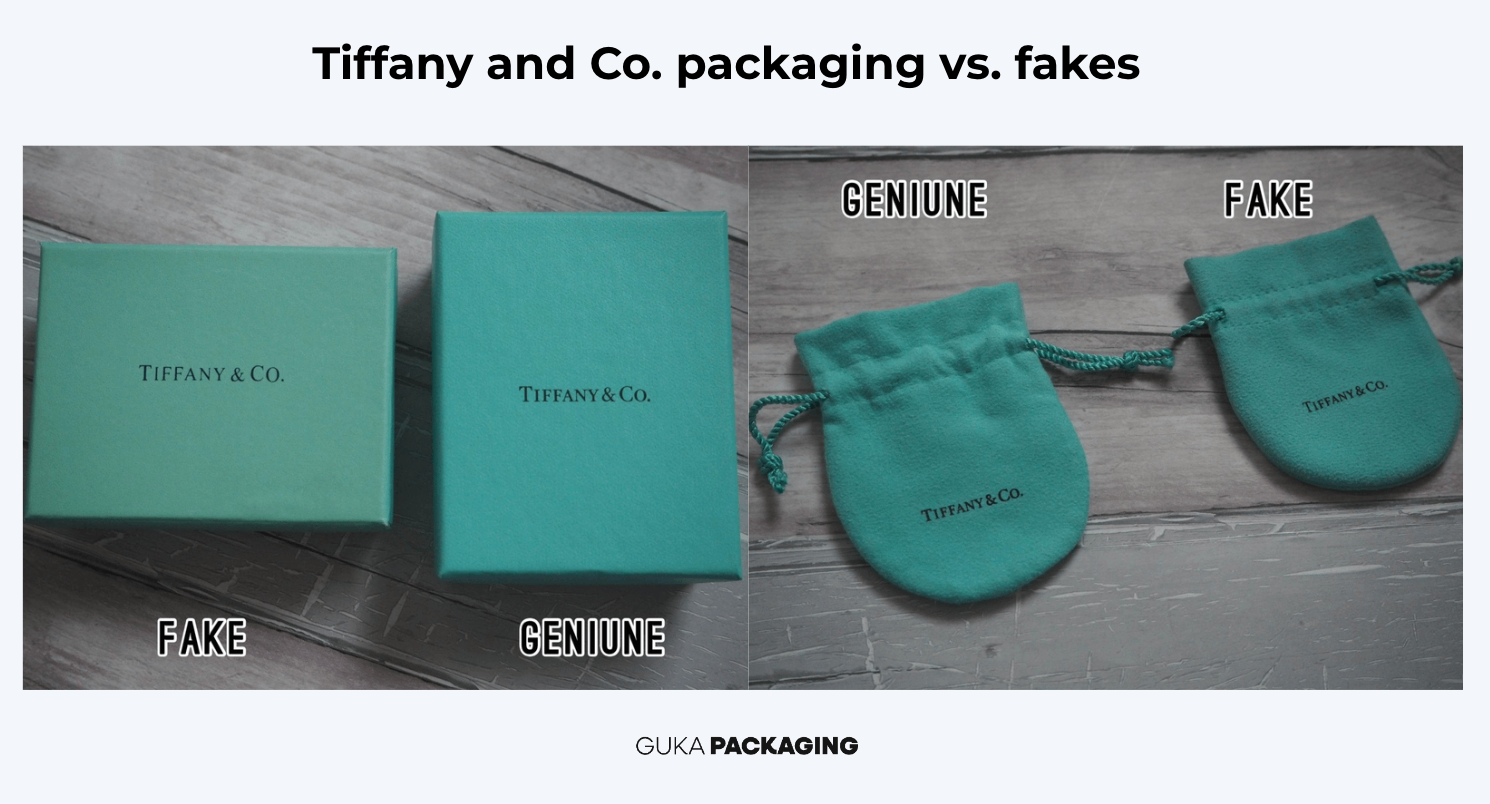
Authentic Tiffany and Co. packaging vs. fakes: checklist to tell them apart
Use this quick checklist (useful for customers, resellers, and quality control teams):
- Color accuracy — authentic boxes match Pantone 1837 precisely; fakes often appear slightly greener, paler, or inconsistent across lighting.
- Material weight & feel — authentic boxes use rigid, dense board and a soft-touch surface; knockoffs feel flimsy or papery.
- Logo quality — embossing/foilstamp should be crisp, centered, and consistent; blurred or off-center printing is a red flag.
- Ribbon & pouch — authentic ribbons are high-grade satin (double-faced), with neat finishing; cheap ribbons fray and look shiny or rough.
- Interior inserts — custom fitted velvet or foam inserts indicate high manufacturing standards; generic or missing inserts imply replica.
- Source of purchase — genuine Tiffany packaging is provided with purchases from Tiffany & Co.; if the box is sold separately, be skeptical.
Why the Tiffany Blue Box endures (brand & manufacturing insights)
- Consistency builds equity: maintaining the same visual cues over decades creates trust and instant recognition.
- Multi-sensory design: color + texture + sound (the snap of a firm magnetic lid) = emotional memory.
- Supply chain discipline: Pantone control, strict material specs, and production QA ensure the product looks the same globally.
- Story + scarcity: when packaging is only available with purchase, it becomes an aspirational artifact.
How to create Tiffany-like packaging for your brand (step-by-step guide)
Below is a manufacturer-aware blueprint that GUKA Packaging uses to develop premium rigid boxes and unboxing experiences for perfume, cosmetics, jewelry, apparel, and more.
Step 1 — Clarify brand positioning & target markets
- Define emotional tone (elegant, playful, minimal, artisanal) for the U.S., Europe, Australia,etc. markets — cultural tastes differ (e.g., minimalist Nordic aesthetic vs. ornate luxury).
- Translate tone into color palette, materials, and messaging.
Step 2 — Choose box structure & mechanics
- Two-piece rigid box for classic gift items.
- Magnetic closure box for high perceived value and repeat use.
- Drawer/shoulder boxes for multiple components (e.g., skincare sets).
Step 3 — Specify materials & finishes (manufacturer checklist)
- Rigid board: choose higher GSM/multi-ply for weight and sharpness.
- Paper wrap: request Pantone-matched or custom-dyed stock; ask for physical swatches.
- Lamination: soft-touch matte or velvet lamination for premium handfeel.
- Finishing: foil stamping, embossing, spot UV — specify foil color/finish and emboss depth.
Step 4 — Interior design & protective inserts
- Custom die-cut EVA/foam or velvet-lined trays sized to product.
- Use branded tissue paper, care cards, or QR code storytelling inserts.
Step 5 — Color control & proofs
- Approve hard-copy color proofs and pre-production samples.
- For critical colors, request spectrophotometer readings or digital color tolerances.
Step 6 — Sustainability: options without compromising luxury
- Recycled/range of recycled content boards, FSC certified paper, and soy-based inks.
- Use mono-materials where possible to improve recyclability while maintaining a premium finish.
Step 7 — Production & logistics for global markets
- Confirm lead times, minimum order quantities (MOQs), and shipping packaging for long shipments to the U.S., EU, or Australia.
- Test fit, drop tests, and consider import regulations (labeling and materials compliance) for each target market.
Practical specification examples (for ordering from a manufacturer)
- Box type: Two-piece rigid box (lid & base) with soft-touch wrap.
- Board: 1200–1500 gsm rigid board (multi-ply).
- Wrap paper: Custom-dye or Pantone matched stock, soft-touch laminate.
- Finish: Blind deboss logo + matte soft-touch lamination.
- Ribbon: 15–25 mm double-faced satin, heat-sealed edges.
- Insert: Custom die-cut EVA with velvet cover.
- Extras: Branded tissue, story card, kraft outer shipping box with foam inserts.
Tips: you can directly copy the below requirements to factory/supplier/manufacturer to get a quick quote
Where to buy or source premium Tiffany-like packaging
If you want manufacturers who specialize in rigid luxury boxes, look for partners who:
- Offer in-house die-cutting, lamination, embossing & foil capabilities.
- Provide physical color proofs and sample programs.
- Have experience shipping to the U.S., Europe, and Australia with international compliance knowledge.
At GUKA Packaging, we produce custom rigid boxes, folding cartons, sturdy corrugated boxes, and branded paper bags for sectors including perfume, cosmetics, jewelry, electronics, and e-commerce. See our inspiration gallery and sample work for luxury rigid boxes here: GUKA Packaging — Luxury Rigid & Magnetic Boxes and client case studies here: GUKA Packaging — Case Studies.
FAQs (quick answers)
Q: What color is the Tiffany box?
A: “Tiffany Blue” is a signature robin’s-egg shade commonly referenced as Pantone 1837 — it’s a trademarked brand color.
Q: Can I use Tiffany Blue for my brand?
A: No — Tiffany Blue is a protected trademark. Choose a unique shade inspired by the same principles (distinctive, consistent, and emotionally aligned with your brand).
Q: How to tell authentic Tiffany packaging vs fake?
A: Check color fidelity, board weight/feel, logo quality, ribbon finish, and whether the box arrived only with an authentic Tiffany purchase.
Q: What box types mimic Tiffany’s presentation?
A: Two-piece rigid boxes and magnetic closure rigid boxes with soft-touch finishes and custom inserts.
Contact GUKA to Get More Info
Tiffany packaging teaches a powerful lesson: consistent color, premium materials, meticulous finishing, and a meaningful unboxing ritual can transform ordinary products into cherished experiences. If your brand sells perfume, jewelry, cosmetics, or luxury goods in the U.S., Europe, or Australia and you want packaging that communicates value at first glance, GUKA Packaging can help.
Explore our premium rigid box solutions and custom packaging services — view luxury examples on our inspiration page and contact our design team to request samples and production quotes. Ready to create an unforgettable unboxing moment? Contact GUKA Packaging today and let’s design your signature box.
You might also interested:
Recommended for you
.avif)
.avif)
.avif)
.avif)


.avif)
.avif)

.avif)
.avif)


You Might Enjoy


Are we right for each other?
We work best with brands that treat packaging as part of the product, not as the last thing on the list. To save us both time, here is who we work with best.
We're probably not the right fit if:
- Orders under $1,000.
- A few boxes, one time.
- Lowest quote wins.
- No conversation, just add-to-cart.
- Brand direction still up in the air. Our FAQ covers the basics first: process, scale, sampling, finishing, production. Worth reading before submitting anything.
We're a strong fit if:
- Projects starting around $1,000 and up.
- Sampling before production makes sense to you. It runs from $300, though complete artwork and locked specs can sometimes skip straight to the line.
- There's real budget behind the packaging, and an expectation that production standards get defined properly.
- What's needed is a manufacturing partner across structure, material, process and delivery. Not a print shop taking a file.
- The box has a job: retail shelf, gifting, unboxing. It has to carry the brand.
- Getting it right matters more than getting it cheapest.
Sound like your project? Let's talk
What happens after you submit
1. A specialist reviews your project, usually within 1 business day.
2. We follow up with questions, options, and indicative pricing.
3. Once the spec is confirmed, we move to sampling.